

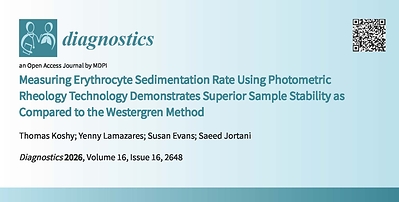
Alcor Scientific’s iSED® analyzers reshape lab logistics and improve patient care for one of medicine’s most widely used tests
- Seven times longer stability, independently validated. ESR samples on Alcor Scientific’s iSED analyzer remained accurate for up to 28 hours at room temperature and 48 hours refrigerated, outperforming the four-hour limit of traditional Westergren testing.
- A breakthrough for modern lab logistics. The extended sample stability delivers workflow and cost savings for clinical labs navigating scattered blood collection sites, longer courier routes and staffing shortages.
- Improved patient care. With more than a full day of room-temperature stability, delayed and after-hours samples can be tested with confidence, reducing rejections and blood redraws while improving results and the patient experience.
SMITHFIELD, R.I., Sept. 17, 2026 /PRNewswire/ — For a hundred years, one number has quietly governed erythrocyte sedimentation rate (ESR), a test doctors rely on to diagnose and monitor infections, autoimmune conditions and other diseases: four. As in four hours, the narrow window in which a traditional ESR sample had to be tested or refrigerated before its result could no longer be trusted. A new peer-reviewed study published in Diagnostics says that deadline belongs to the past.
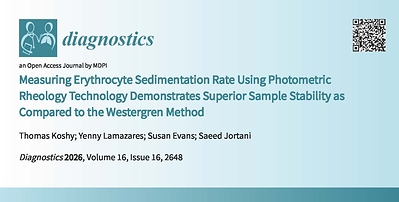
The study found that ESR samples measured by photometric rheology on Alcor Scientific’s iSED® analyzers remained accurate for up to 28 hours at room temperature and 48 hours refrigerated, seven times longer than the traditional Westergren method’s four-hour room-temperature limit.
The impact is significant. One of the most widely used tests in medicine is no longer bound by a four-hour deadline. As clinical labs contend with scattered Blood collection sites, longer courier routes and staffing shortages, the extended sample stability delivers immediate benefits to labs and the patients they serve.
The full study “Measuring Erythrocyte Sedimentation Rate Using Photometric Rheology Technology Demonstrates Superior Sample Stability as Compared to the Westergren Method,” is Available at https://www.mdpi.com/2075-4418/16/16/2648.
The Problem hiding in the back of a courier van
ESR is one of the oldest tests in medicine, and one of the most widely ordered, with millions performed every year. It’s a fast and affordable marker of inflammation that helps detect and monitor a range of conditions, from infections and autoimmune diseases like rheumatoid arthritis to inflammatory conditions like giant cell arteritis, as well as certain cancers. Unlike tests that measure a specific molecule, ESR measures a behavior: how quickly red Blood cells aggregate and settle in a tube, which makes it acutely vulnerable to time and temperature.
That vulnerability collides head-on with how modern labs operate. At the same time, labs are consolidating into centralized, high-volume centers, they’re navigating growing blood collection sites and staffing shortages. Between the needle and the analyzer sits a courier network that batches specimens onto multi-stop routes, often carrying them for hours in vehicles with no meaningful temperature control. Meeting a strict four-hour clock Across that chain is often impossible. Worse, the failure is invisible because a degraded sample doesn’t arrive flagged. It arrives looking perfectly normal, and its result gets reported and acted on like any other.
Beyond gravity: a new way to measure inflammation
The iSED analyzer takes a fundamentally different approach to ESR testing. Using photometric rheology technology, it optically captures red blood cell aggregation, the earliest and most critical step of erythrocyte sedimentation, inside a temperature-controlled flow cell, generating a result in less than 20 seconds. Because it reads the very beginning of the aggregation process in a controlled environment, the iSED Analyzer is largely insulated from the time-sensitive changes that undermine traditional readings, extending sample stability seven times longer than traditional testing.
From four hours to 28: a breakthrough for labs
Extending sample stability from four hours to 28 in ESR is a breakthrough for laboratory logistics, offering labs and the patients they serve immediate, tangible benefits, including:
- Reliable results: greater confidence in every result, especially when samples travel long distances or are delayed.
- Fewer rejected samples: specimens delayed in transit or received during minimal-staffing hours can still be tested with confidence.
- Fewer needle sticks for patients: sparing patients the burden of repeat phlebotomy for a common blood test.
- One tube, two tests: with longer stability, the same EDTA tube can realistically serve both ESR and CBC testing, and add-on ESR requests become feasible.
- Workflow and cost savings: a meaningful advantage as clinical laboratories navigate deepening workforce shortages.
“For decades, labs have been forced to build their entire ESR workflow around limited sample stability. Extending room temperature stability by an additional 24 hours is a game changer, not only improving logistics but truly improving patient care by ensuring reliable results. Giving labs a full day of reliable stability isn’t a convenience. It’s better medicine,” said Jim Post, CEO, Alcor Scientific.
About the study
The study, “Measuring Erythrocyte Sedimentation Rate Using Photometric Rheology Technology Demonstrates Superior Sample Stability as Compared to the Westergren Method,” was published in Diagnostics (2026;16(16):2648) by Koshy, Lamazares, Evans, and Jortani. The research was conducted under Institutional Review Board (IRB) approval at two hospital sites and funded by ALCOR Scientific.
About ALCOR Scientific
ALCOR Scientific develops diagnostic technologies that optimize laboratory efficiency. Founded in 2011, the company leverages its deep understanding of bioscience and state-of-the-art manufacturing techniques to design transformational solutions that help health care providers save time and improve patient care. ALCOR Scientific is one of the only providers to offer a fully automated solution for Erythrocyte Sedimentation Rate (ESR) testing for all laboratory throughputs and workflows. For more information, visit alcorscientific.com.
Media Contact
Megan McCutcheon, ALCOR Scientific
Email: mmccutcheon@alcorscientific.com

 View original content to download multimedia:https://www.prnewswire.co.uk/news-releases/new-peer-reviewed-study-confirms-innovative-technology-shatters-esrs-four-hour-deadline-302881181.html